Category: Uncategorized

Here’s a Reliable Online Tool to Help You Choose a Part D Drug Plan!

Here’s a Reliable Online Tool to Help You Choose a Part D Drug Plan!

It’s annual enrollment season again (October 15—December 7), the time of year when you can finally drop that drug plan you hate and shop a new one. The entirety of the drug plan market is available to you, and that’s exciting (well…as exciting as it gets with prescription drugs).


But it’s also overwhelming. I want to make sure you know that a drug plan is unique to you. It is based on your situation, your preferred pharmacy, your location, and—most importantly—your list of medications. It is a challenge to consider everything, especially if you don’t have the right tools.


This is why, on Medicare.gov, they have a shopping tool for drug plans. You put in all your information, and the system ranks all of the available drug plans based on total cost.


Total Cost is the Boss!

Total cost is not just the premium. It includes the premium, of course. But it takes into account all that you pay in an entire year in a given plan. This includes copays, coinsurance, deductibles and all the unexpected costs a plan may hide under the cloak of a low premium.


A plan may be $18.40 a month, but if it doesn’t cover one of your prescriptions or has excessive copays, it may not be the best-valued plan for you. This is why total cost should dictate your choices, not the premium.


Using the Medicare.gov drug plan shopping tool takes this into account, and it’s actually easy to use. Just follow these simple steps, and let it do the number crunching for you:

  1. Go to https://www.medicare.gov.
  2. Click on “Find health and drug plans”.
  3. Enter your zip code into the general search bar.
  4. When a pop-up window appears, choose your county.
  5. Enter your basic information.
  6. Enter your medications and dosage.
  7. Click “My Drug List is Complete”.
  8. Add your pharmacy.
  9. Select “Prescription Drug Plans (with Original Medicare)” and click “Continue to Plan Results”.
  10. Shop the available plans!

(Any questions or concerns? Just leave it in the comments. We love to hear from you!)


Good luck and happy Annual Enrollment Period! I recommend taking care of all the changes to your health care plans now, so that when the holidays roll around, (they’ll be here faster than you think; they always are!) you don’t have to deal with it!

In other words, focus on what needs to be done now, so you can focus on what really matters later.


Think you’re spending too much on Medicare Supplement Insurance? Call Seniormark at 937-492-8800 for a free consultation!


Be sure that you have covered all of your bases by downloading our handy “Annual Enrollment Checklist”!


Medicare Answers at a Glance: Should I Delay Part B?

Medicare Answers at a Glance: Should I Delay Part B?


Medicare Part A is free, so there isn’t much hesitation to enroll outside of HSA contribution issues. But with Part B, there is a $121.80 associated premium, so those approaching 65 are a little bit leery. Do I really need it?


Let’s make this clear: most people do. So before you make the decision to opt out, make absolute sure that you are one of the few who don’t!


You should NOT delay Part B if…


1.  You are retiring from work.

Retiree insurance or COBRA doesn’t count. If you don’t have employer insurance through active employment, the answer is simple: don’t delay Part B. You will be left without outpatient coverage for as long as don’t enroll, and you will incur penalties if you sign up late!

2.  Your employer’s health insurance plan covers 20 or less employees.

Just because you have employer insurance and are still working does not give you an all-access pass to opt out of Part B. If the plan doesn’t cover at least 20 people, you should definitely enroll in Part B. But take careful note. The number of employees is not always the same as the number of insured employees. Some temporary or part-time workers may not be covered on the employer insurance plan. Check with your employer before making any hard and fast decisions.

3.  Your employer insurance is more expensive

This may seem obvious, but I felt compelled to include it. Just because you can delay Part B doesn’t mean you want to. Analyze the costs and benefits of both Medicare and your employer insurance to determine which is the better value.


If these three criteria don’t apply to you, you may very well qualify to delay Part B. But I always recommend running your situation past a Medicare expert to make sure. Retirement decisions are as complex as they are important. Get help when you need it!


Need Medicare questions answered? Download our free guide, “Introduction to Medicare”.  No high-pressure sales pitches here, just in-depth discussion about the ins and outs of Medicare!


Medicare: It’s as easy as A B C…and D

The Jackson Five’s number one hit single in 1970 takes the convoluted topic of love and boils it down to a few letters. Sweet simplicity. “All you gotta do is repeat after me,” Michael sings, “It’s as easy as A B C.”


Well, I figured if the Jackson Five can make love easy to understand, the least I can do is attempt the same thing with the complexities of basic Medicare. So here goes nothing. Medicare: it’s as easy as parts A B C…and D.


Part A (Inpatient Coverage)

Part A is hospital insurance. A.K.A inpatient care. A.K.A healthcare coverage for any care received while you are officially checked in at a hospital. Beyond that definition, Part A also covers limited home health services, hospice care, and skilled nursing facility care. If you paid into Social Security for more than 40 quarters (10 years), then good news! Part A is provided at no cost to you.


Part B (Outpatient Coverage)

Part B is exactly the opposite, covering care received while checked out of a hospital. It covers services such as outpatient surgeries, diagnostic tests, lab tests, x-rays, and a laundry list of preventive services that are covered in full. Unfortunately, Part B does have an associated premium of $121.80 per month (in 2016), a fee which is adjusted for those of higher income (don’t worry…this applies to very few people).


Part C (Medicare Advantage)

Part C is a whole different ball game. So pay attention, it could get a bit messy. Although Part C is offered as a Medicare associated program, it actually replaces Medicare Parts A and B as the payer of your claims. As opposed to being offered by Medicare, it is offered by private insurance companies who have contracted with Medicare. It covers everything that Parts A and B covers and may even provide additional benefits such as drug coverage. However, you usually have to pay a separate premium to receive Part C.


Part D (Drug Plan)

Part D helps cover the bills for your pills! In other words, it is your prescription drug coverage. Like Part C, it is offered through private insurance companies. And like Part B, the premiums are sometimes (but rarely) adjusted for those of higher income. The cost is difficult to pin down because it varies so drastically from company to company. But—just to give you an idea—the average cost of a Part D drug plan is $34.10 (in 2016).


At Seniormark, we believe that the transition to Medicare does not need to be confusing and stressful. We would love talk to you about your options to get you in the right plan for your needs. Medicare may not be as easy as the Jacksons’ suggest, but that does not mean it cannot be made simple with the help of our trusted experts. So sit down and relax! Let us spell it out for you.
Not sure what to do next? To get you started, download our free guide, “Introduction to Medicare”. 


Call Seniormark today at 937-492-8800 for a free consultation!

Medicare Supplement Policyholder Alert!

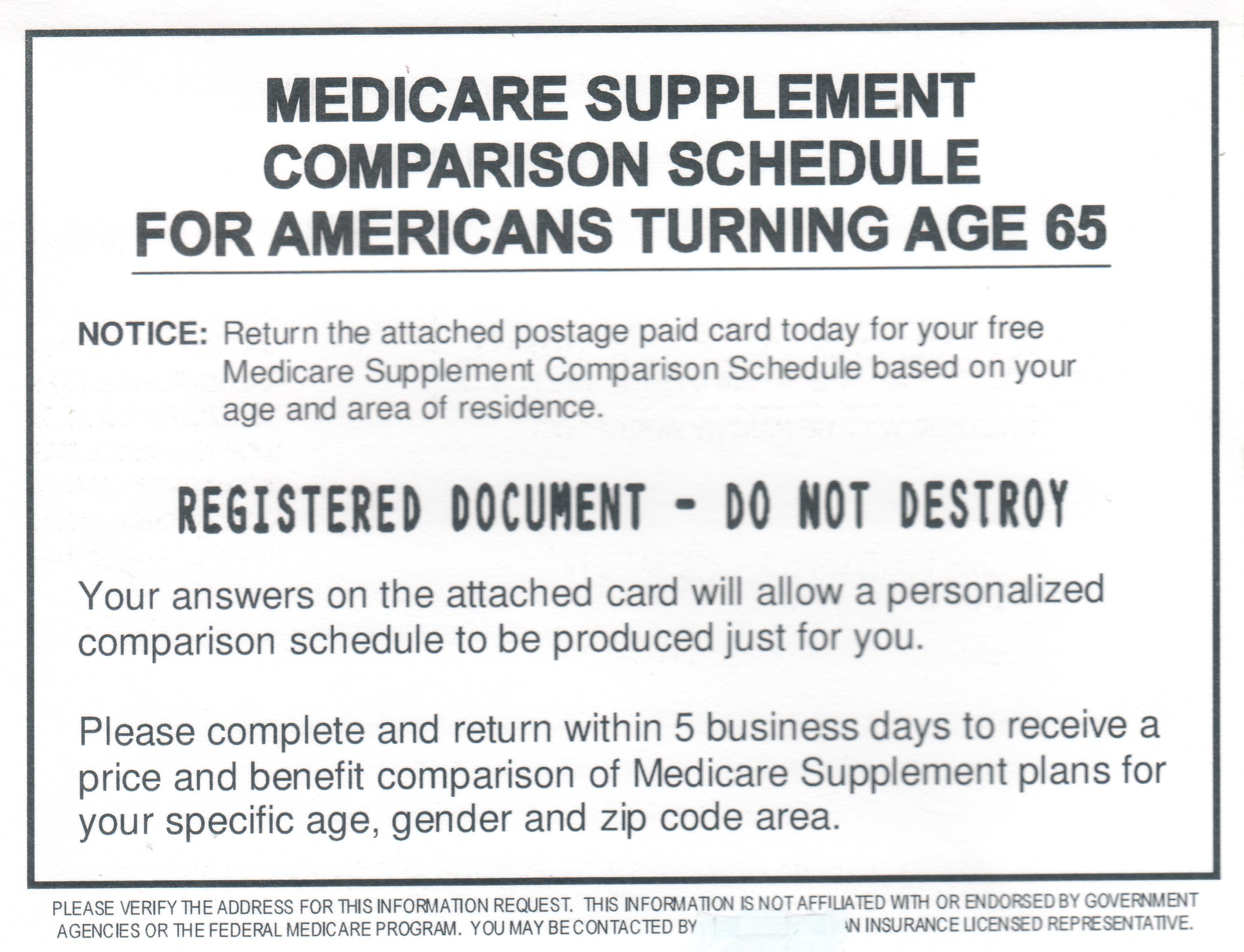
postcard33Have you received this postcard in the mail?  Is it coming from Medicare?  Is it important information?  It does say, “REGISTERED DOCUMENT – DO NOT DESTROY.”  The truth is this is just a solicitation for insurance, and if you mail in the return postcard you are sure to get a call from an insurance agent, or worse yet a knock on your front door.  The unfortunate truth is we now live in a world of information overload and everyone is vying for your attention…yes, even me.  And in the world of Medicare, some lead companies resort to making the older population believe their mailing is more than it is.

If you look closely at the small print at the bottom you will read, “This information is not affiliated or endorsed by government agencies or the federal Medicare program.  You may be contacted by an insurance licensed representative.”  This disclaimer language is a sure sign that the mailing is a solicitation as it is required by Medicare.  I am not judging those who use these postcards to drum up business, in fact these cards are completely compliant with current regulations.  I just believe there is a better way…honesty!

Why can’t we replace the words, “REGISTERED DOCUMENT – DO NOT DESTROY” with, “THIS IS NOT A REGISTERED DOCUMENT – DESTROY IF YOU WANT…BUT IF YOU DO, OUR AGENCY WON’T BE ABLE TO HELP YOU!”  Why can’t we just get back to letting people know we are here to help when they need it.

Here is a great example:

https://www.youtube.com/watch?v=FrmYLo3tMA8

Attention Medicare Supplement Policyholders…Congress is after YOU!

Shortly after taking over one of the largest sectors of our economy, healthcare, Congress is at it again.  This time they are going after your Medicare Supplement insurance.

For well over the past two years Congress has been focusing on ways to reduce Medicare spending.  They are focusing on Medicare Supplement coverage because they believe that Medicare Supplement policyholders over utilize their Medicare benefits because they have very little or no out of pocket cost since their policy picks up all the deductibles and coinsurance that Medicare doesn’t cover.  I won’t go into why this is not altogether accurate, but for now let’s just focus on the changes they want to make.

Their goal is to completely revise the structure of Medicare as it exists today, using the famed Simpson/Bowles report as a “solution.”  They want to do this by adding more “cost sharing” to Medicare, or as they like to put it, they want Medicare recipients to have “more skin in the game.”  Joe Baker of the Medicare Rights Center hits the nail on the head when he said that “cost sharing” is really “cost shifting.”  And guess who the cost is shifted to?  That’s right, YOU.

So what does this Simpson/Bowles report call for?

  1. Combining the current Part A and Part B deductibles into one $550 deductible.
  2. A single coinsurance rate of 20% up to $5,550.
  3. Set coinsurance cost at 5% between $5,550 and $7,500
  4. Set an annual out-of-pocket maximum at $7,500.
  5. Prohibit Medicare Supplement policies from covering the first $550 and limit coverage to 50% of the next $5,000.

That last one is a biggie, as Medicare Supplement policies are currently allowed to cover these deductibles and coinsurance.  Even if they don’t move forward with #5 above, the president has suggested implementing a 15% tax on Medicare Supplement policies that provide these first dollar benefits, such as Medicare Supplement plans C or F.  That means you would pay more money just because you choose to have good coverage.  Also, there are already Medicare Supplement plans that include more “cost sharing,” so these options already exist for those who want them.

A nationwide survey conducted in 2012 showed that 9 out of 10 Medicare Supplement policyholders were satisfied with their coverage, and 91% would recommend a Medicare Supplement policy to their friends when they turn 65.

The problem with Medicare is not what is coming in the front door through more “skin in the game” payments from you.  The real problem is the $50 billion dollars each year that is going out the back door through Fraud, Waste and Improper payments.  I believe it makes much more sense to focus on these expenses rather than ask our Medicare population to pay more.  If you agree, I strongly encourage you to call or write your Senator and Congressman and inform them that “Cost Sharing” and “More Skin in the Game” is not good legislation.

You can view a video on this subject below:

Capture3

Important Part D info for seniors! Pass this on!

D-resized-600


With the Medicare Annual Enrollment Period coming to a close on December 7th, I have some important info for everyone that may prevent you from having hundreds (if not thousands) of dollars out of pocket for 2014.

Many Medicare recipients who like their current prescription drug plan coverage make the decision to just let their plan renew for the coming year without reviewing the Annual Notice of Change packet they received from the company in late September.  It is OK to let your plan renew for the new year, but at a minimum I highly recommend that you review the plan’s formulary list (a list of medications that they will cover) to make sure that the medications you take will be covered.  Don’t assume that just because your medication was covered by your plan in 2013 that it will automatically be covered for 2014!

I recently met with a gentleman who had not reviewed his formulary list and was going to just continue his plan into 2014.  After recommending he review the list, he found that his Januvia had been dropped off the formulary for 2014.  Had he not caught this and switched to a different plan, he would have been stuck with paying for this medication out of pocket for the entire year…at a cost of $300/month.

So take 10 minutes right now and review your formulary list or call the customer service number on the back of your id card and they can check for you.  Your wallet may be very happy you did!

Important information for those on Medicare!

It has been brought to our attention (thanks to our clients) that several medicare supplement/medicare advantage agents in the area have been going door to door soliciting new business.

If you don’t know, it is illegal for an agent to stop at your door uninvited. We even have one report where our client was told that her medicare supplement Plan G was being discontinued by Medicare, which is totally untrue.

If this happens to you, please do us and yourself a favor and let them know they are not allowed to solicit door to door. If they don’t agree, direct them to Ohio Administrative Code 3901-8-09, Section (D)(2)(a).

Also, if you are considering making any changes to your existing plans, give us a call before you do…(937) 492-8800.

Can Medicare Advantage survive PPACA?

Here is a great article about how the Patient Protection and Affordable Care Act (aka Obamacare) may affect the Medicare Advantage program…

Can Medicare Advantage survive PPACA? | BenefitsPro.

Part B or Not Part B…That is the question

One of the most commonly asked questions I receive is, “I am turning 65 and I have employer health insurance, do I need to sign up for Part B of Medicare?”

To start, let me explain what Parts A and B are.  Part A of Medicare covers inpatient care in a hospital or skilled nursing facility, while Part B covers doctor’s visits and other outpatient care.

For most Medicare beneficiaries, the Part A decision is easy because it doesn’t cost anything.  Therefore, most people will sign up for Part A as soon as they turn 65.  But the Part B decision can be a little more complicated, since you have to pay a monthly premium for Part B which is $104.90 for most individuals.

When deciding whether to sign up for Part B, the first question you need to answer is whether you have employer health insurance through your employer based on your active employment or if you are covered under your spouse’s employer plan based on his/her active employment.  The key word here is “ACTIVE.”  If your health coverage is based on active employment, then whether you decide to delay Part B will depend on the number of people employed by the employer providing the insurance.

If there are 20 or more employees at the company where you or your spouse work, then the employer insurance pays first and Medicare pays second.  If this is the case then you may want to delay enrolling in Part B as long as you are happy with the employer coverage and the cost is not too high.

If there are fewer than 20 employees then Medicare pays first and the Employer plan pays second.  In this scenario you should not delay enrolling into Part B.  If you decline Part B you will have no primary insurance for doctor office visits or outpatient services, which is usually like having no insurance at all.

In either case, as long as you have coverage from active employment, you will have a Special Election Period to enroll in Part B when you retire with no late enrollment penalty.  It is important to remember that COBRA and retiree insurance are not considered current employer insurance and you will not have a Special Enrollment Period.  If you have COBRA or retiree insurance and delay enrollment in Part B you may have to pay a penalty when go to sign up.

Medicare is a big animal with a lot of rules, so it is important to discuss your personal situation with an expert before you make these decisions.